Conserving Metalwork at the Flatiron Building
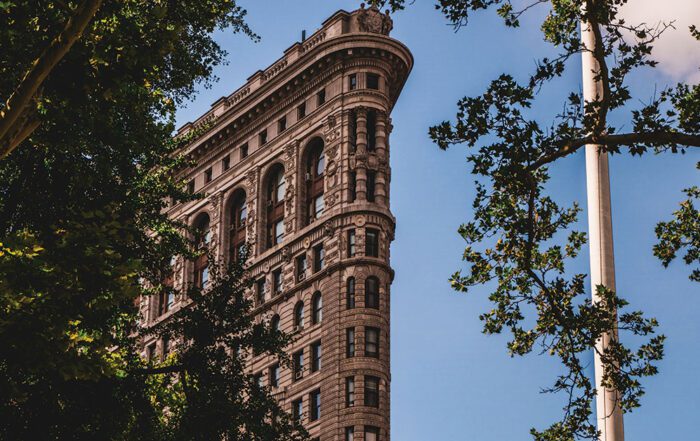
Few buildings in the architectural canon are as immediately legible as the Flatiron Building. Completed in 1902, the Flatiron is one of New York’s most recognizable structures. Its triangular form is instantly familiar, but what often gets overlooked is the level of craftsmanship embedded throughout the building—particularly at the points where people actually enter and interact with it.
Our current work focuses on two arched bronze grille systems located above the main entrances on Fifth Avenue and Broadway
Working Within a Disciplined Architecture
Working at the Flatiron isn’t about adding something new. It’s about getting something right.The building’s geometry is precise, and its proportions are unforgiving. Any new element has to fit seamlessly into what’s already there. The arched grilles follow the curvature of the openings exactly, reinforcing the shape and rhythm of the entrances without drawing attention away from the building itself. From our perspective, that’s the goal: when the work is finished, it shouldn’t stand out. It should feel like it belongs.
Bronze as a Time-Based Material
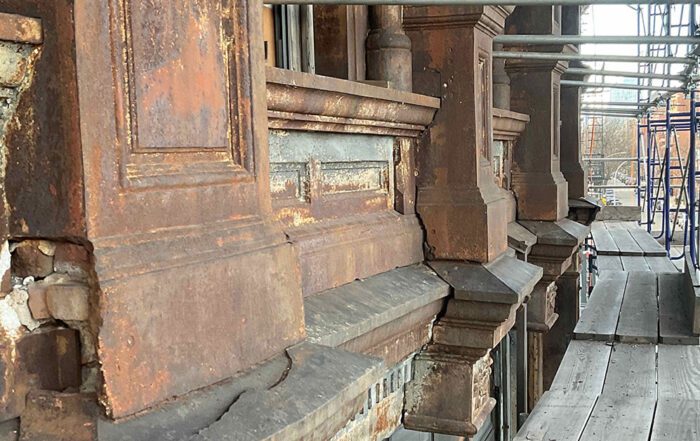
Bronze is a material that tells the truth about age. Over decades of outdoor exposure, bronze naturally reacts with moisture and air, forming surface corrosion and patina. Many people associate this aging with the green tones seen on historic metalwork, but that color is actually the result of ongoing chemical change. Without maintenance and protection, corrosion can continue beyond the surface and begin to affect the integrity of the metal. At a building like the Flatiron, managing that process matters. Cleaning and conservation are approached with restraint. Bronze is cleaned using the most effective methods, following established conservation standards. The intent is not to strip away history, but to stabilize the material and prepare it for long-term protection.
Conservation and Long-Term Protection
Where bronze elements have fractured or weakened over time, repairs are necessary to prevent further damage and to maintain structural support—especially where metalwork interfaces with glass or masonry. Once cleaning and repairs are complete, a protective wax coating is applied. This coating acts as a barrier against moisture and environmental exposure and is a standard step in outdoor bronze preservation. Depending on climate and conditions, the wax protection typically lasts one to three years and should be renewed as part of a regular maintenance program. Long-term preservation is the result of consistent care.
Craft at the Architectural Margin
What makes working on the Flatiron special isn’t the attention it receives—it’s the level of accountability the building demands. Every curve, joint, and surface finish is measured against architecture that has stood for more than a century. There’s no room for approximation. The work has to hold up visually, structurally, and materially—not just today, but decades from now.
When the grilles are installed, the best outcome is quiet success: elements that do their job, respect the building, and fade into the larger story of a structure that continues to endure.
Fabrication and Conservation of Arched Bronze Grilles
Material
Architectural-grade bronze alloy chosen for durability and patination potential.
Patternmaking
Custom patternmaking and casting used to achieve accurate curvature, consistent thickness, and structural stability.
Cleaning & Conservation
Bronze is cleaned using gentle, conservation-approved methods to remove corrosion while preserving sound material and existing patina.
Repairs
Damaged or fractured bronze components are repaired to restore structural integrity and support adjacent materials such as glazing.
Protective Coatings
A conservation-grade wax coating is applied as the final step to protect the bronze from moisture and environmental exposure. Wax protection typically lasts 1–3 years depending on conditions.