Look Closer: The Historic Bronze Doors of the University of Michigan’s Rackham Building
There is a good chance you could walk past them without stopping.
The great bronze and glass doors of the Horace H. Rackham School of Graduate Studies at the University of Michigan feel so naturally integrated into the building’s monumental limestone architecture that, at first glance, they read simply as part of the entrance: functional, handsome, and appropriate.
But look closer, and something more expressive appears.
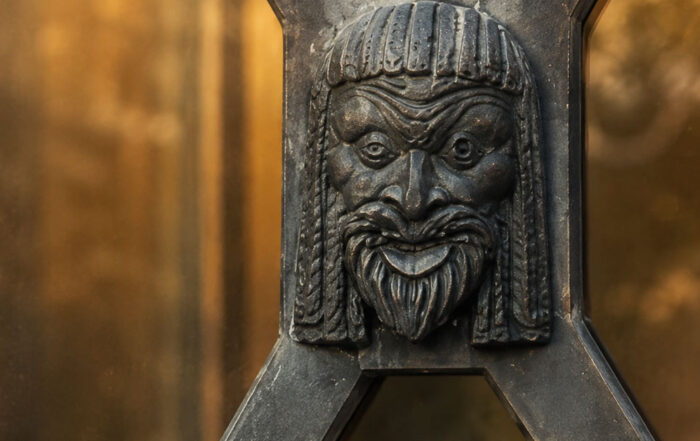
At the crossing point of the doors’ X-shaped bronze framework, where the cast bronze elements converge, are small sculptural faces. Each one is different, with its own expression, character, and sense of life. Some appear stern. Some feel theatrical. Others seem calm, watchful, or almost mischievous.
They are among the details that make the Rackham Building so extraordinary — and they are part of what makes historic bronze restoration meaningful work.
A Building Shaped by an Unlikely Fortune
To understand the doors, it helps to understand the building and the man whose name it carries.
Horace H. Rackham was a Detroit attorney who, in 1903, helped prepare the incorporation papers for a small new automobile company founded by Henry Ford. Instead of taking a simple legal fee, Rackham invested in the company, becoming one of Ford Motor Company’s original shareholders. That investment eventually became an extraordinary fortune, much of which Horace and his wife, Mary, directed toward philanthropy.
After Horace Rackham’s death in 1933, Mary Rackham helped fund a new graduate school building at the University of Michigan in his name. Opened in 1938, the Rackham Building became one of the university’s most distinguished architectural landmarks.
Kapp, Parducci, and the Greco-Deco Spirit
The building was designed by William E. Kapp of Smith, Hinchman & Grylls, one of Detroit’s leading architectural firms. Kapp’s design balanced classical permanence with the streamlined geometry and decorative energy of the Art Deco period.
The building’s materials reflect that ambition: Indiana limestone, a granite base, copper roofing, bronze window and door casings, and finely finished interior spaces. Nothing about the building feels accidental. Architecture, material, sculpture, and ornament all work together.
A key figure in that ornamental program was Corrado Parducci, the Italian-American architectural sculptor whose work appears on hundreds of buildings, including many of Michigan’s most significant early twentieth-century landmarks. Parducci became known for a style often described as “Greco-Deco,” blending classical figures and ancient references with the flattened forms and bold rhythm of Art Deco design.
At Rackham, that sensibility is visible in the building’s sculptural reliefs, decorative forms, and bronze detailing. The doors belong to that same visual language.
The Faces in the Bronze
The masks set within the Rackham doors do not appear to have a documented one-to-one meaning, at least not one that is readily available. But their presence is far from random.
Mask-like faces, sometimes called mascarons, have been used in architecture for centuries. They can suggest theater, mythology, protection, wisdom, comedy, tragedy, or human expression. On an academic building, especially one connected to graduate study and intellectual life, those associations feel especially fitting.
The Rackham masks recall the classical world, but they are not delicate copies of ancient ornament. They are compact, stylized, and integrated directly into the bronze framework. Their placement at the center of each X-shaped panel turns structure into sculpture. The doors are not only an entrance. They are a threshold between the outside world and the life of the mind within.
That is what makes them so compelling. They ask people to slow down, look closer, and notice the human hand within the architecture.
What Time Does to Bronze
Bronze is one of architecture’s most enduring materials, but it is not untouched by time.
Over decades, bronze responds to moisture, pollution, handling, temperature changes, and environmental exposure. Its surface can develop patina, staining, discoloration, corrosion, and wear. In historic work, those changes must be approached with care. The goal is not to erase age or make old bronze look newly manufactured. The goal is to stabilize the material, protect the surface, and preserve the character that gives the work its historic value.
That is especially important when sculptural details are involved.
A small mask, casting, profile, or joint may seem minor compared to the scale of a building, but these are often the places where the architect’s vision and the sculptor’s hand are most visible. If they are over-cleaned, flattened, altered, or replaced without sensitivity, something irreplaceable is lost.
Preservation Is Not Replacement
For Allen Architectural Metals, restoring historic bronze doors like these requires more than technical ability. It requires an understanding of original design intent, historic materials, and the relationship between ornament and architecture.
The work is not about making the doors look new. It is about preserving what exists, stabilizing what is vulnerable, and restoring the bronze in a way that respects the building’s history.
The Rackham doors are a reminder that great architecture often reveals itself in details. In every cast bronze face, every worn edge, and every sculptural intersection, there is evidence of the artists, architects, and craftspeople who shaped the building nearly a century ago.
Some things are worth preserving.
These doors are among them.
More From Allen Metals